
The Great Divide
An unspoken battle for the future of advertising.
There are two major interpretations of where the ad industry is going. They map nicely to James Hurman’s theory of Future Demand.
Put (too) simply, Hurman’s contention is that advertising works in two ways: we either capture existing demand, or create future demand. The entire digital advertising era has been very, very focused on capturing existing demand, and the industry (primarily via ad platforms and mostly-advertising tech companies like Google and Meta) has been very successful at that.
Whether or not they’ve been successful at building brands and delivering lasting business results is much more debatable.
But this has led to a crossroads. The biggest players in what is usually thought of as the ad industry are holding companies, and they are leaning very hard into trying to be more like the tech companies that have reshaped the industry around capturing existing demand. Right down to the restructuring, rebranding, and mass layoffs, the WPPs, Omnicoms and Publicises of the world have gone all in on “we’re a tech company now”, with AI investment abounding and a promise that the future is technology driven efficient advantage. The creative agencies they have not yet shuttered seem destined for the same status as the in-house agencies at Meta and Google, that is, loss-leaders for media sales. (Ironically this is very 1960s advertising thinking, just for a world without monopoly laws). Orbiting around this are many performance and efficiency focused agencies that are consciously engaging in a race to the bottom, with the intention to win. This is the Church of Existing Demand, and the orthodoxy is positively stifling.
On the other end of the spectrum are the independent creative agencies. I am very biased, because this is my world and my competitive set. But almost all of these companies are looking for the quality advantages that new technologies can crank out, while keeping the focus on making work that people remember, like, think about. Earning attention and affection, rather than just buying and optimizing for it. This is a doctrine of effectiveness that is fundamentally about creating future demand (and future customers). Capturing existing demand isn’t ignored, but it’s a secondary priority, largely because this has already been optimized to within an inch of it’s life by the massive advertising-supported tech companies that both own the platforms, and are building much of the tech that underpins the AI optimized future of performance marketing.
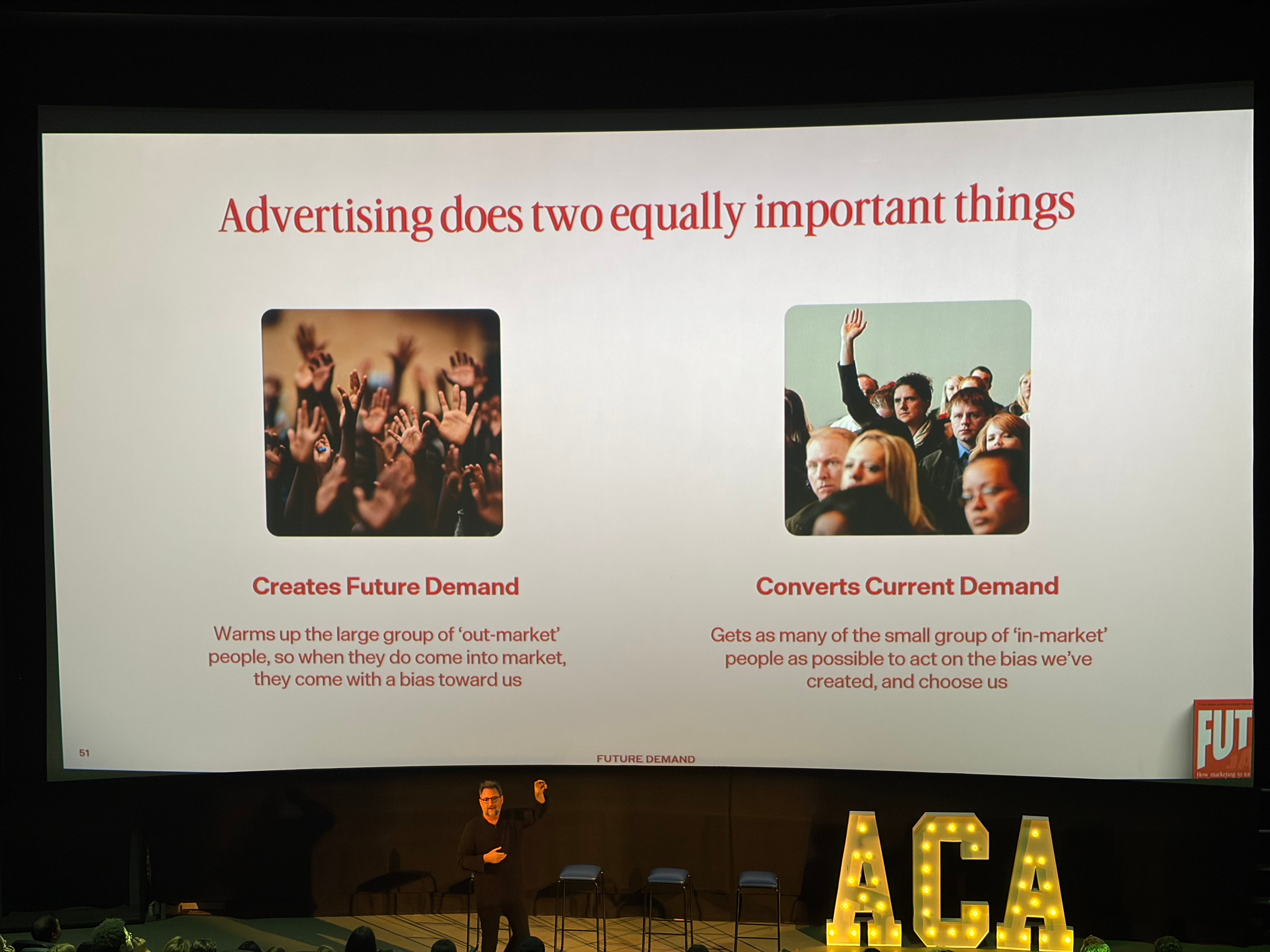
The obvious truth is that you need both. You need to efficiently capture existing demand, but also create demand for the future so you can survive past the next quarter. The issue is, this isn’t only an argument about what the most effective way to build an industry and deliver results is.
This is actually about what the word “advertising” means.
When I was a kid (I know, I am ancient) advertising meant 15 and 30 second TV spots, billboards, print ads (magazine and newspaper), and radio, primarily. The internet has opened up a ton of new options for what advertising can be, and people LOVE some of them: well done influencer marketing, UCG collabs, streaming sponsorships, in-game experiences, DTC merch drops, and custom content can be well-liked. But if you ask a random person in 2026 how they feel about advertising, what they’re thinking about isn’t any positive experiences. (I ask people this regularly, and it’s not fun.)
“Advertising” has started to mean stalking, punishment and public shaming.
With the current uproar about surveillance capitalism and surveillance pricing, the stalking point is hitting a new level. People are angry that advertisers are developing deep “anonymous” profiles of them and targeting them in ways that are uncomfortable to explain. In general, I think if you dropped an average person into a presentation from a modern media platform (especially one with a retail / loyalty layer) they would be horrified.
If the value exchange of “we give you points so we can figure out exactly when your kids move out, so we can start pushing you ads for discount boxes of wine right as the loneliness hits” was fully legible, most people would be deeply uncomfortable. But this even extends to the feelings people have about endless targeted email offering you predatory services and terms, spam that can never be filtered away, and retargeted ads that keep checking if you want a product that is forever sold out in your size.
The line between scams, spam, and advertising is effectively invisible, today. That is an industry defining problem on a much larger scale than, say, AI.
When the number of unskippable ads increases dramatically over time, or when pausing results in another ad break, or when it’s a solid 120 seconds to get to the next part of a 10 minute video, it feels like advertising is a way of the platform in question bullying you into either giving them more money, or finding a technology solution to work around it. If the ‘ad burden’ is high enough for adblocking to become even semi-popular, it’s not sustainable.
And finally there’s the fact that in 20 years we went from Jeff Bezos arguing advertising was a tax on a lack of innovation, to Scott Galloway arguing advertising is a tax on the poor. The shift to advertising being only for the “low end” versions of products, primarily digital ones, is stigmatizing both working in the industry, and consuming its output.
All of this comes down to one thing: we need to stop letting the Existing Demand-Only people define what advertising means.
Advertising based on Future Demand tries to entertain people. Inspire them. Build positive associations and additive experiences. Ideally build cultural moments. And those things are still happening. But they aren’t being associated with the word “advertising”. Popularly, the word is more defined by banner ads than by anything that gets acknowledged at Cannes.
I only really see two choices here: either we stand up for the stuff that has value beyond efficiency, and champion that it should be the standard bearer for this industry, taking priority over the other stuff, OR, we abandon the label of “advertising” and pick a new word for the parts of this trillion dollar industry that don’t immediately make people angry, dismissive, or disgusted.
I’m not ready to give up yet.
Not directly related to the above, but in a similar vein of believing in advertising: I’m both proud and excited to be part of the team working on Rebrief, a new Canadian Journal of Advertising. You can learn more on the website, substack or instagram, but the short version is: this is a group of people who love the Canadian ad industry enough to want it to be better. The first print issue (coming this summer) will include personal essays, fiction, analysis, and a wide range of perspectives on the question “what is Canadian advertising?”
If this sounds interesting, sign up, learn more, and potentially even sponsor the issue to get in front of the influential audience of people shaping the present and future of one of the industries most influential markets.